Imagine a computer so powerful that it can solve complex problems in seconds—problems that would take even today’s most advanced supercomputers thousands of years to process. This is not a distant dream or science fiction; it is the transformative promise of quantum computing.
As one of the most groundbreaking technological advancements of the 21st century, quantum computing is rapidly reshaping how we think about computation and problem-solving. Unlike classical computers that rely on bits, quantum computers leverage the principles of quantum mechanics to process information in fundamentally new ways. This opens the door to unprecedented computational power and efficiency.
The future of quantum computing holds immense potential to revolutionize industries across the globe. From accelerating drug discovery in healthcare and optimizing financial models, to enhancing cybersecurity and advancing artificial intelligence, its applications are vast and far-reaching. As research and innovation continue to push boundaries, quantum computing is poised to become a cornerstone of next-generation technology.In this article, we embark on a comprehensive exploration of the future of quantum computing—unpacking its core principles, examining its current challenges, and understanding the profound impacts
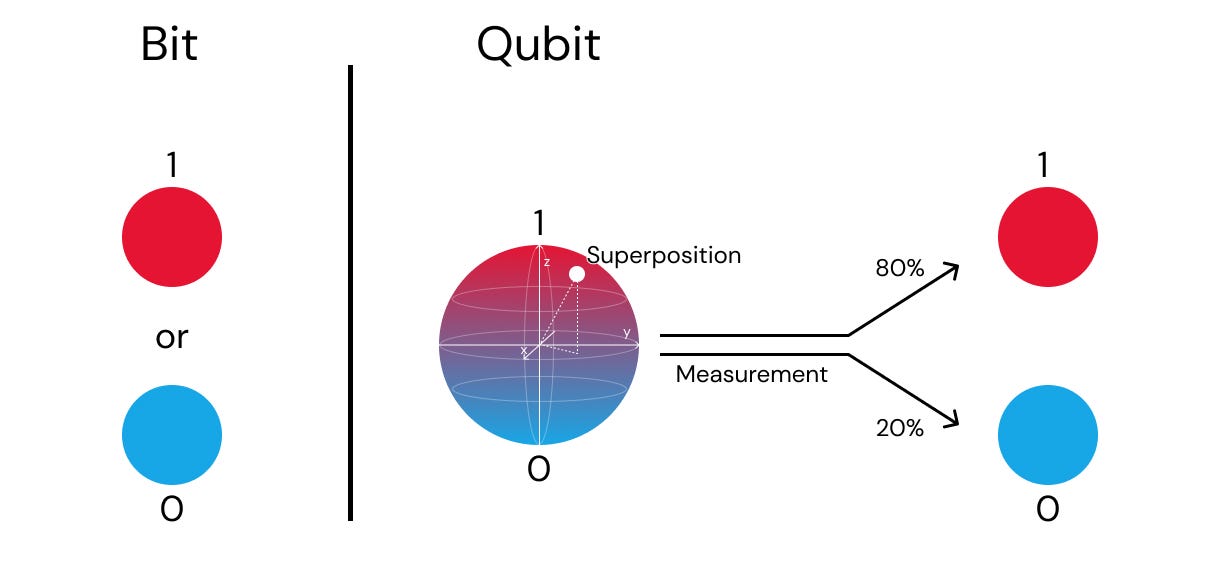
Quantum computing is a new and advanced form of computing based on the principles of quantum mechanics, the branch of physics that studies the behavior of matter and energy at the smallest scales. Unlike traditional computers, which process information using bits that exist as either 0 or 1, quantum computers use qubits (quantum bits)—a fundamentally different unit of information.
A qubit (quantum bit) is the basic unit of information in quantum computing. While a classical bit can only be in one of two states—either 0 or 1—a qubit can exist in a combination of both states at the same time. This unique capability allows quantum computers to handle complex computations much more efficiently.
Qubits are typically created using quantum systems such as electrons, photons, or atoms. Their behavior is governed by the laws of quantum mechanics, which gives them extraordinary computational potential compared to classical bits.
Superposition is the ability of a qubit to exist in multiple states simultaneously.
This means a quantum computer can evaluate many possibilities at once, rather than processing them one after another. As more qubits are added, the computing power grows exponentially.
Example:
(A system with 3 classical bits can represent only one combination at a time (like 101), but 3 qubits can represent all possible combinations (000, 001, 010, 011, 100, 101, 110, 111) simultaneously.)
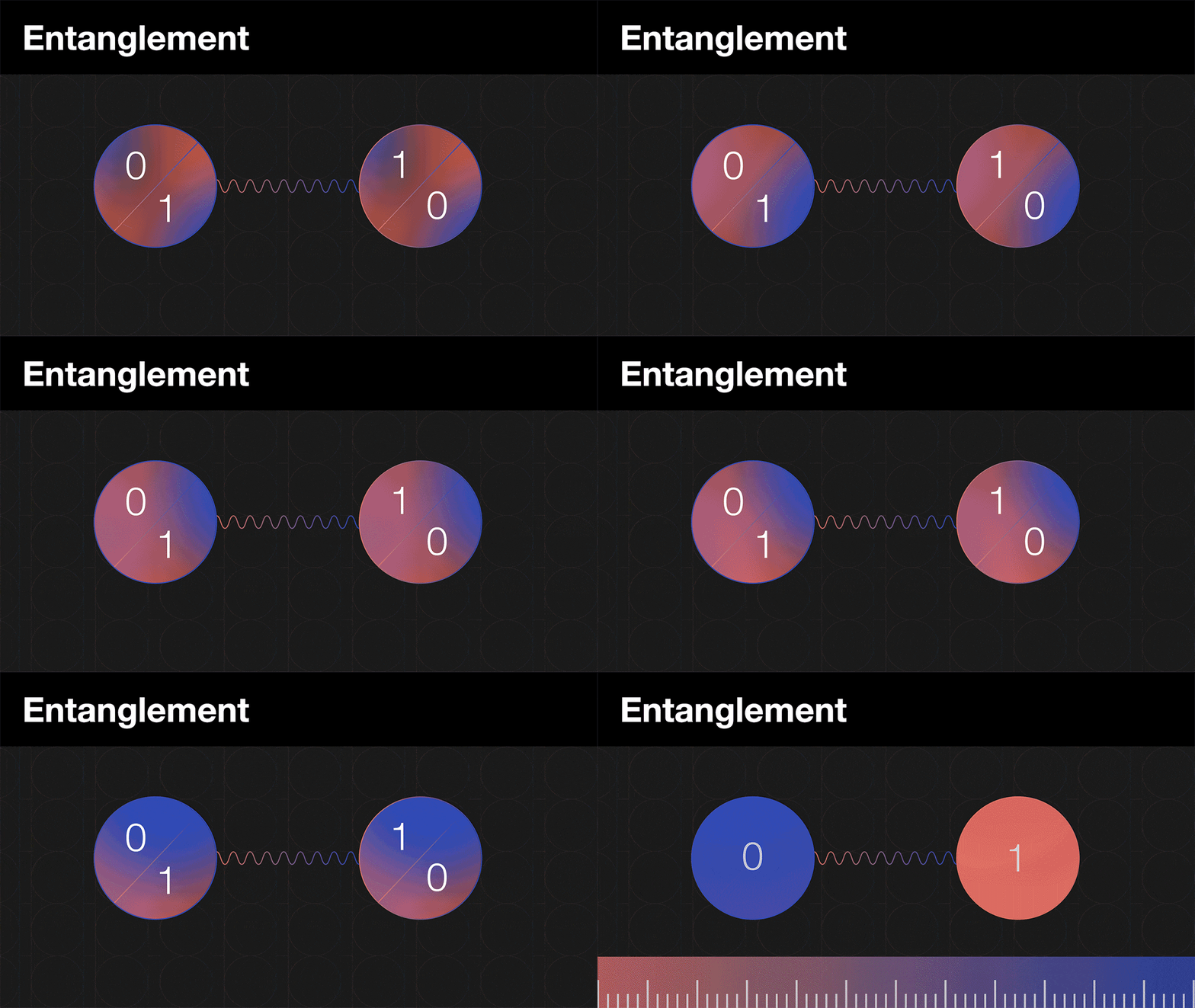
Entanglement is a phenomenon where two or more qubits become interconnected in such a way that the state of one qubit directly affects the state of another, no matter how far apart they are.
Entanglement enables quantum computers to perform complex calculations more efficiently by coordinating multiple qubits in a highly synchronized way.
Example:
(If two qubits are entangled and one is measured as 0, the other will instantly be determined as 1 (or vice versa), even if they are physically separated.)
Quantum computers operate in a fundamentally different way from classical systems. Instead of processing information step by step, they use the principles of quantum mechanics to explore many possibilities at once—making them incredibly powerful for specific types of problems.
At the heart of a quantum computer are qubits, which store information. These qubits are manipulated using quantum gates, the building blocks of quantum circuits. Unlike classical logic gates, quantum gates can transform qubits into complex combinations of states, enabling parallel computation on a massive scale.
These operations are organized into quantum circuits, where sequences of quantum gates are applied to qubits to perform calculations. Through this process, a quantum computer can evaluate multiple potential solutions simultaneously and converge on the most probable answer.
Qubits are the core units of quantum information. Their ability to exist in multiple states at once allows quantum systems to handle complex computations far beyond classical capabilities.
Quantum gates are used to manipulate qubits. They control superposition and entanglement, enabling the system to perform sophisticated calculations through quantum circuits.
The Quantum Processing Unit (QPU) is the brain of the quantum computer. It executes quantum operations and runs algorithms, similar to how a CPU functions in classical computers—but with far greater computational potential for certain tasks.
A classical control system manages and directs the quantum processor. It sends instructions, controls operations, and interprets the results produced by the quantum system.
Quantum computers require extremely low temperatures—often close to absolute zero—to function properly. The cooling system ensures qubits remain stable and reduces interference from environmental noise.

Quantum computing is still in its early stages of development, yet it is progressing at an impressive pace. Today’s quantum systems are often described as part of the NISQ (Noisy Intermediate-Scale Quantum) era—meaning they possess significant computational potential but are not yet powerful or stable enough for large-scale, real-world applications.
In this phase, quantum computers can perform certain specialized tasks and experiments, but they are not ready to replace classical computers. Instead, they serve as a crucial stepping stone toward more advanced, fault-tolerant quantum machines of the future.
Our journey into the world of quantum computing highlights both the immense potential and the significant challenges of this revolutionary technology. By harnessing the principles of quantum mechanics, quantum computers have the ability to transform industries ranging from scientific research and healthcare to cybersecurity and beyond.
As the technology continues to evolve, it is essential for individuals, researchers, and organizations to stay informed and prepared for its impact. Quantum computing is not just a technological advancement—it represents a shift in how we approach problem-solving, innovation, and discovery.
The future of quantum computing holds extraordinary promise. As research progresses and systems become more stable and scalable, quantum computers are expected to transition from experimental environments to practical, real-world applications. In the coming decades, they may become a vital part of our technological ecosystem, working alongside classical computers to solve problems that are currently beyond our reach.

Quantum computing is not just a technological breakthrough—it is also a catalyst for new career paths, business models, and innovation across industries. As the technology continues to evolve, it is expected to unlock a wide range of opportunities in several key domains.
Quantum computing is giving rise to a new era of quantum software development. Developers will need to learn specialized programming languages and frameworks designed for quantum systems.
This opens up exciting opportunities for developers to work at the cutting edge of technology and shape the future of computing.
Quantum computing is heavily driven by innovation, making research and development one of the most important areas of opportunity.
Researchers, scientists, and engineers will play a crucial role in pushing the boundaries of what quantum systems can achieve.
Quantum computing is set to significantly impact the field of cybersecurity—both as a challenge and an opportunity.
As traditional encryption methods may become vulnerable, there will be a growing demand for experts in quantum-safe security solutions.
Quantum computing has the potential to transform data science by enabling faster and more efficient data processing.
This creates opportunities for data scientists to leverage quantum computing for deeper insights and faster decision-making.

The integration of quantum computing with Artificial Intelligence (AI) is opening new possibilities for faster, smarter, and more efficient systems. While traditional AI relies on classical computing power, quantum computing introduces a fundamentally different approach—allowing AI to tackle problems that are currently too complex or time-consuming.

AI systems often rely on processing massive datasets. Quantum computers can evaluate multiple possibilities simultaneously, significantly speeding up data analysis.
This means AI systems can deliver results quicker and more effectively.
Quantum computing can improve machine learning by optimizing algorithms in ways classical computers cannot.
This leads to more accurate and efficient AI models.
Many AI applications involve solving optimization problems, such as finding the best route, minimizing costs, or maximizing efficiency.
Quantum computing excels at:
This is especially useful in industries like logistics, finance, and manufacturing.
AI relies heavily on identifying patterns in data. Quantum computing enhances this by enabling deeper and faster pattern analysis.
This results in smarter and more reliable AI systems.
Modern AI models often deal with high-dimensional datasets, which can be difficult for classical systems to process efficiently.
Quantum computing can:
This allows AI to extract more meaningful insights from complex data.
Quantum computing has the potential to transform deep learning by accelerating neural network training and improving performance.
Quantum computing marks a revolutionary shift in technology, using principles like qubits, superposition, and entanglement to solve complex problems far beyond the reach of classical computers. Although still in its early stages, rapid advancements are bringing it closer to real-world applications.
Its impact will be significant across industries such as healthcare, finance, cybersecurity, data science, and artificial intelligence. As quantum computing continues to evolve, it will create new opportunities, drive innovation, and work alongside classical systems to tackle challenges once considered impossible.
In essence, quantum computing is not just the future of technology—it is the next big leap in human progress.